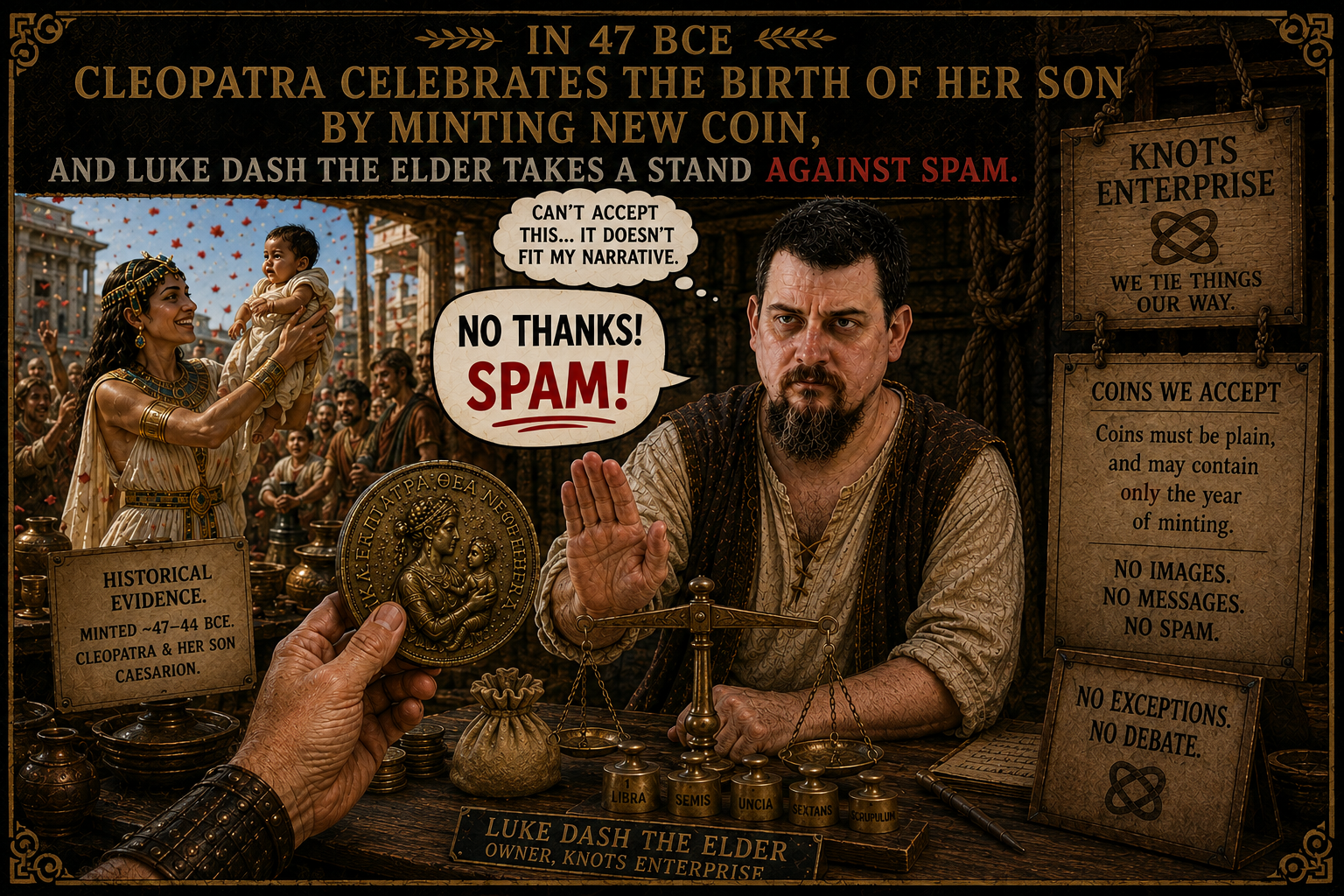
What is spam?
BIP-110 rests on a deceptively simple premise: Bitcoin is "permissionless as money, not as data storage." The proposal treats this distinction as self-evident — that there exists a clean line between monetary data and non-monetary data, and that a protocol rule can enforce it.
But the history of money tells a different story.
Data has always been part of money
When Cleopatra minted coins bearing her portrait and that of her newborn son Caesarion around 47 BCE, she was not performing a monetary act and a data act separately. The message was the money. The coin's authority, its identity, and its political statement were inseparable from its function as a medium of exchange.
This was not an exception. It was the rule. For as long as money has existed, non-monetary information has accompanied it:
- Ancient rulers stamped coins with portraits, titles, and religious symbols — we know some kings only because their coins survived.
- Every banknote in circulation today carries national symbols, portraits, serial numbers, and security features that are "data," not "money."
- Modern payment systems routinely carry user messages — invoice references, memo fields, and remittance information. SWIFT MT103 messages contain up to 4x35 characters of free-text sender-to-receiver information. This is not a bug; it is a feature.
- Chinese merchants in the Tang dynasty wrote poems and personal messages on paper money. The practice was so widespread that surviving notes are studied as literary artefacts.
The boundary between monetary data and non-monetary data has never been clean. A coin bearing Cleopatra's face is data. A transaction tagging an invoice number is data. A banknote's serial number is data. None of these are "money" in the narrow sense — yet all are inseparable from money's function.
If these are not spam, then "spam" cannot simply mean "non-monetary data on a monetary instrument."
Who gets to write on money?
Historically, there was an important limitation. The power to decide what messages money carried belonged to its issuers — kings, states, central banks, and payment networks. The Tang dynasty poet could scribble on a banknote, but the symbols printed on it were chosen by the emperor. The SWIFT memo field exists because the network's designers permitted it.
Bitcoin changed that relationship.
Satoshi demonstrated the principle in the genesis block, embedding a newspaper headline — not as a ruler asserting authority, but as an individual leaving a mark. OP_RETURN has existed since 2014. Timestamping protocols, coloured coins, and commitment schemes have used Bitcoin's data-carrying capacity for over a decade.
For the first time in the history of money, ordinary users can embed messages in a monetary system without requiring permission from its issuer. This is not a bug that appeared with Ordinals. It is a property that has existed since block zero.
BIP-110 restores the old rule
BIP-110 would close that door selectively. It would preserve the coinbase — where miners can still embed data — while restricting the tools available to ordinary users. In effect, it re-establishes the rule that has governed money for millennia:
Those who mint may message; those who transact may not.
The proposal's authors may not intend this outcome. But it is the structural consequence of restricting user-accessible data embedding while leaving miner-accessible data embedding untouched.
If messaging has always been part of money — and history says it has — then the question is not whether Bitcoin should carry data. It always has. The question is whether Bitcoin will be the first monetary system where that privilege extends beyond the minters to the users themselves.
BIP-110 says no. History suggests that is the wrong answer.